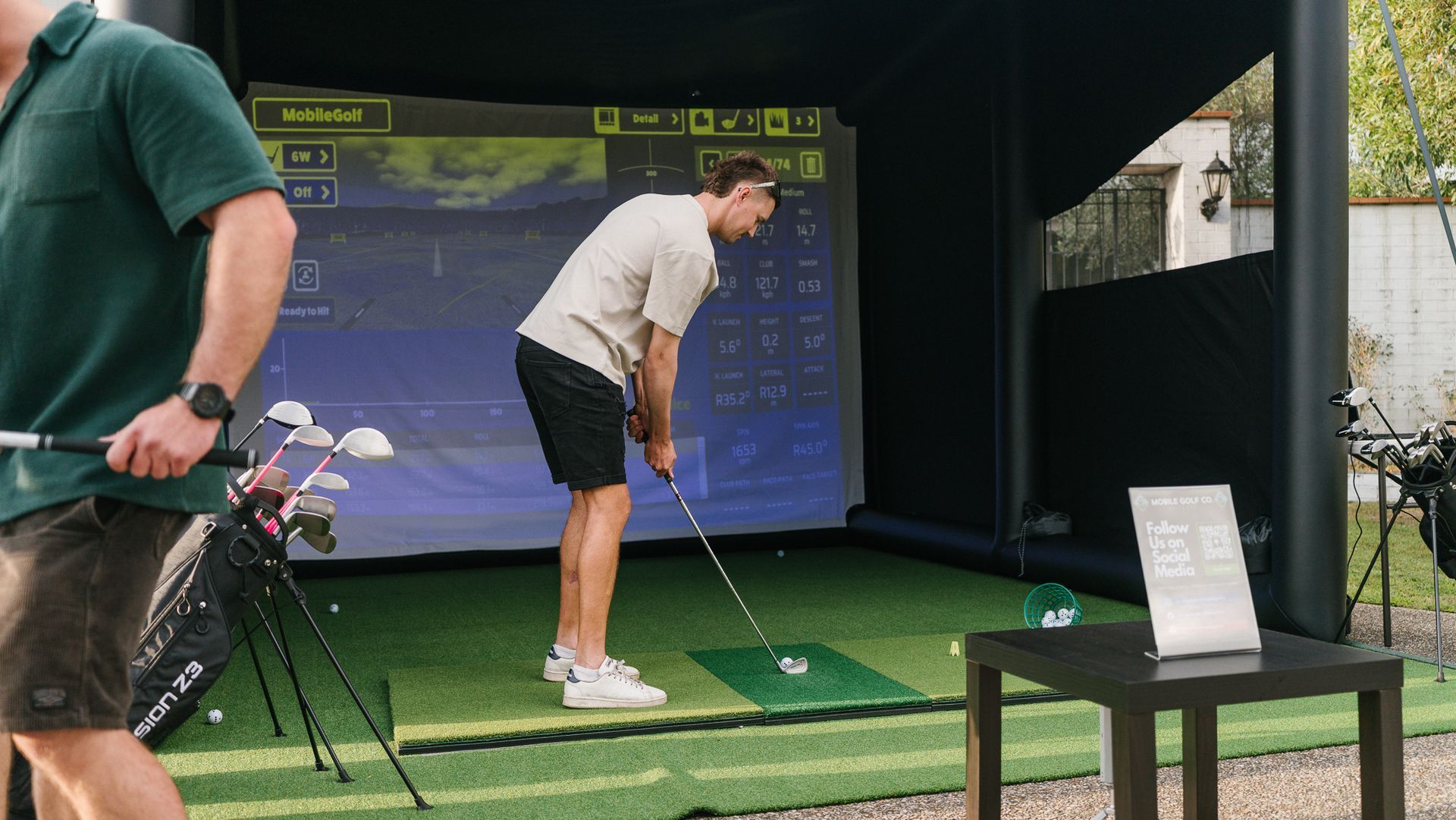
What good launch monitor numbers actually look like, club by club
Most golfers have access to launch monitor data now. Few of them actually know what the numbers should be.
They'll hit a 7 iron, see ball speed 118 km/h, smash factor 1.39, launch angle 18°, spin rate 6,200 rpm — and have absolutely no frame of reference for whether any of that is good, bad, or somewhere in between. The data is right there on the screen. The benchmark isn't.
That gap is worth fixing. Once you know what you're aiming for, a launch monitor stops being a novelty and starts being a coaching tool. Here's a club-by-club breakdown of ideal launch monitor metrics, what they mean, and how amateur golfers typically measure up.
The four numbers that matter most
Before getting into the benchmarks, these are the metrics worth tracking across every club:
Ball speed — how fast the ball leaves the clubface, measured in km/h. This is your power output. Everything else being equal, faster ball speed = more distance.
Smash factor — the ratio of ball speed to clubhead speed. A smash factor of 1.50 means the ball left at 1.5x the speed your club was travelling. It's the efficiency number. The max smash factor on a driver is around 1.50 — physics limits how much energy the club can transfer to the ball. Irons typically sit lower because they're designed with more loft and less face flex.
Launch angle — the angle the ball launches off the face relative to the ground. Too low and you're losing carry. Too high and you're losing distance to excessive height. Every club has an optimal window.
Spin rate — measured in revolutions per minute (RPM). Driver spin is the enemy of distance. Iron spin is your friend — it's what holds the green.
These four interact constantly. A high smash factor matters less if your launch angle is too low. A great launch angle is wasted if your spin rate is too high. The goal is getting all four into their optimal range at the same time.
Driver benchmarks
The driver is where most amateur golfers have the most room to gain.
| Metric | Tour average | Amateur target | Common amateur result |
|---|---|---|---|
| Ball speed | 270–290 km/h | 220–250 km/h | 180–220 km/h |
| Smash factor | 1.48–1.50 | 1.44–1.48 | 1.35–1.43 |
| Launch angle | 10–14° | 12–15° | 8–11° |
| Spin rate | 2,200–2,700 rpm | 2,500–3,000 rpm | 3,200–4,500 rpm |
The biggest issue for most amateurs: too much spin, too low a launch. The ball climbs fast, balloons, loses speed in the air, and drops short. A spin rate above 3,500 rpm on a driver is almost always costing you distance — and the fix is usually in the delivery, not the equipment.
Smash factor is your quality-of-strike indicator. Below 1.40 on a driver and you're leaving significant yards on the table with every swing, regardless of how hard you're swinging.
3-wood and fairway woods
Fairway woods are where amateurs consistently underperform relative to their iron game.
| Metric | Amateur target |
|---|---|
| Ball speed | 195–225 km/h |
| Smash factor | 1.42–1.47 |
| Launch angle | 12–16° |
| Spin rate | 3,000–4,000 rpm |
Launch angle on a 3-wood is naturally lower than driver because the loft is lower. Most amateurs try to help the ball up, which delofts the club through impact, drops the launch angle further, and spikes the spin. Trust the loft. Sweep through it.
Long irons (3–5 iron)
Long irons are the hardest clubs in the bag to hit well. The data confirms it.
| Metric | 4 iron target | 5 iron target |
|---|---|---|
| Ball speed | 165–185 km/h | 155–175 km/h |
| Smash factor | 1.38–1.43 | 1.38–1.43 |
| Launch angle | 14–18° | 16–20° |
| Spin rate | 4,500–5,500 rpm | 5,000–6,000 rpm |
The lower the loft, the harder it is to generate enough spin to keep the ball in the air and land softly. If your long iron smash factor is below 1.35, you're either catching it thin or hitting it heavy — and a 5 iron you're mis-hitting will carry less than a well-struck 7.
Most amateurs who've moved to hybrids at the 3–5 iron range made the right call. The launch angle and spin rates are easier to access with a hybrid head.
Mid irons (6–8 iron)
This is where most golfers have their most reliable data. Mid irons are the most-hit clubs on a launch monitor.
| Metric | 6 iron | 7 iron | 8 iron |
|---|---|---|---|
| Ball speed | 155–175 km/h | 145–165 km/h | 135–155 km/h |
| Smash factor | 1.38–1.44 | 1.38–1.44 | 1.38–1.44 |
| Launch angle | 17–21° | 18–22° | 21–25° |
| Spin rate | 5,500–6,500 rpm | 6,000–7,000 rpm | 7,000–8,000 rpm |
A good smash factor question: what is a good smash factor for a 7 iron? Anything above 1.40 is clean contact. 1.44 is excellent. If you're consistently hitting 1.35 or below, the strike is off — off the toe, heavy, or early extension through the shot.
Mid iron spin rates should be high enough to land and stop on a green. If your 7 iron is spinning below 5,500 rpm, the ball is going to run out on landing.
Short irons (9 iron, pitching wedge)
Short irons are built for control. Higher loft = higher spin = more stopping power.
| Metric | 9 iron | Pitching wedge |
|---|---|---|
| Ball speed | 125–145 km/h | 115–135 km/h |
| Smash factor | 1.35–1.40 | 1.30–1.38 |
| Launch angle | 24–28° | 26–30° |
| Spin rate | 8,000–9,500 rpm | 8,500–10,000 rpm |
At this range, ball speed matters less than spin rate and launch angle combination. A 9 iron that launches at 26° with 9,000 rpm of spin is doing its job. One that launches at 22° with 6,500 rpm is going to roll out like a 7 iron on landing.
Wedges (gap, sand, lob)
Wedge data is trickier to benchmark because the distance you're hitting it matters. A 60° lob wedge from 80 metres behaves differently than a full-swing lob.
| Metric | Full swing target |
|---|---|
| Smash factor | 1.22–1.30 |
| Launch angle | 28–36° |
| Spin rate | 8,500–12,000 rpm |
High spin on wedges is the target. 10,000+ rpm is achievable with a clean strike, fresh grooves, and the right ball. If you're not seeing spin in this range, check the grooves — worn wedge grooves drop spin significantly.
For amateur golfers, the main win in the wedge data is usually identifying a mismatch between carry distance and total distance. A wedge with 12,000 rpm of spin lands and stops. One with 7,000 rpm runs out 6–8 metres further. That mismatch, repeated across a round, costs shots.
How to read your own data
The benchmarks above are starting points, not pass/fail grades. A few practical ways to use them:
Start with smash factor. It tells you whether the problem is swing speed or contact quality. If your smash factor is low, more effort produces more of the same bad result. Fix contact first.
Check launch angle before adjusting loft. Most launch angle problems are delivery issues, not equipment problems. Getting fitted for higher-lofted equipment to compensate for a shallow delivery is a workaround, not a fix.
Spin rate and ball match. The same swing can produce very different spin rates with different balls. If you're optimising for wedge spin, a premium urethane cover ball is worth the difference in price.
Use our full launch monitor data guide to understand how all these metrics interconnect — smash factor, carry vs total distance, spin axis, and what the shot tracer is actually showing you.
For a closer look at the technology capturing these numbers — the launch monitor we use at every Mobile Golf Co activation — see our post on how the Rapsodo MLM2 Pro measures your swing and why it makes a difference at events.
Curious what your own numbers look like? Request a quote and bring your swing — we'll give you something real to work with.
Related: Understanding your launch monitor data — smash factor, spin rate and more · Golf simulator corporate events
Here's Some Other Posts You Might Like